
By Jennifer Zell, MIG Director of Regenerative Design
Some places ask you to slow down the moment you arrive. Highland Springs Ranch & Inn, tucked beneath the San Gorgonio Mountains in Cherry Valley, is one of them. Lavender fields sway in the breeze. Deodar cedars and magnolia trees perfume the air and cast shadows across the landscape. Visitors gather over tea, sourdough bread, olive oil, and wine—all produced from the surrounding land. It’s easy to think of it simply as a beautiful agrotourism destination. But beneath the beauty is something more intentional.
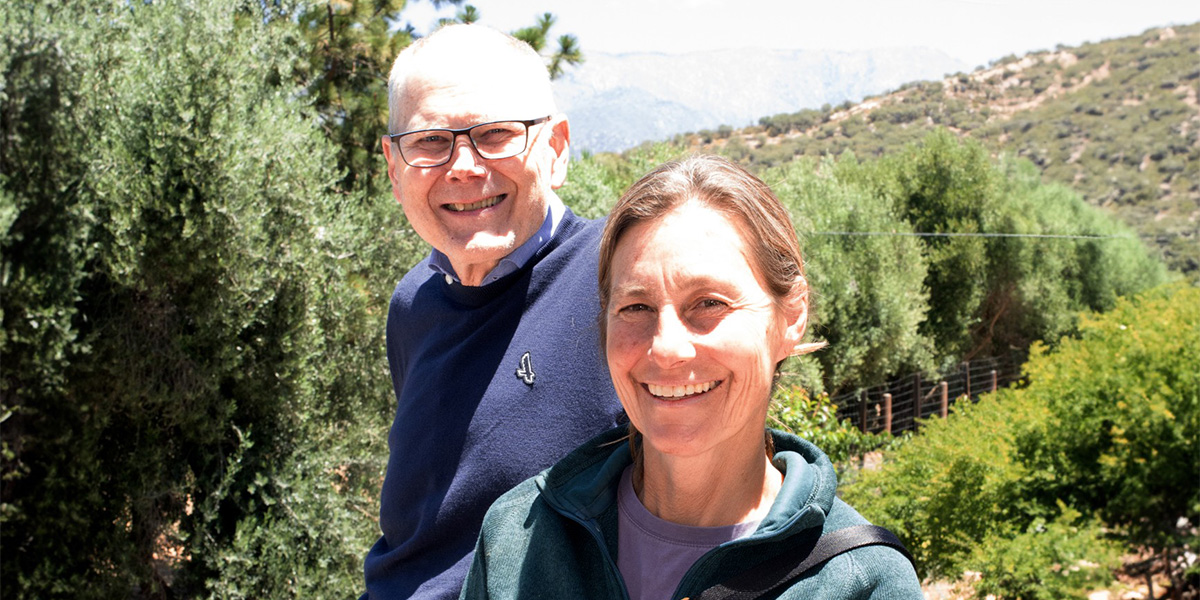
For Tina Kummerle and Stefan Hoff, Highland Springs Ranch & Inn is an ongoing practice of regeneration—of the land, of historic buildings, and of a deep sense of responsibility to this place and its history. Once a stagecoach stop along the Bradshaw Trail, later a celebrated health resort and retreat, Highland Springs Ranch & Inn has welcomed notable visitors including Ernest Hemingway, Albert Einstein, and Elizabeth Taylor. The property has entered a new chapter rooted in ecological stewardship.
That philosophy touches nearly every corner of the ranch. Organic lavender fields, vineyards, olive groves, and gardens are managed using regenerative practices that build healthy soils, conserve water, and encourage biodiversity. Wildlife is treated not as a nuisance but as part of a larger ecosystem. The same thinking extends to Black Bench, the ranch’s 16-acre vineyard. After helping protect the property from residential development in 2008, Tina began cultivating the site using regenerative and agroforestry principles—planting native trees alongside vines, eliminating tillage, growing cover crops, and working toward a resilient food forest that supports both agriculture and habitat.
Regeneration has become a familiar word in recent years, but what does it actually look like in practice? How do you balance farming and making a living with land stewardship and peaceful coexistence with crop destroying squirrels and gophers? How to prioritize habitat over yield, or efficiency over complexity, and certainty over the unpredictability that comes with letting nature participate?
Those are some of the questions we explore in this conversation with Tina and Stefan. We’ll talk about the long history of Highland Springs, the philosophy that guides their work, the realities of regenerative agriculture, and why they believe the healthiest landscapes are those where people and nature are allowed to thrive together.
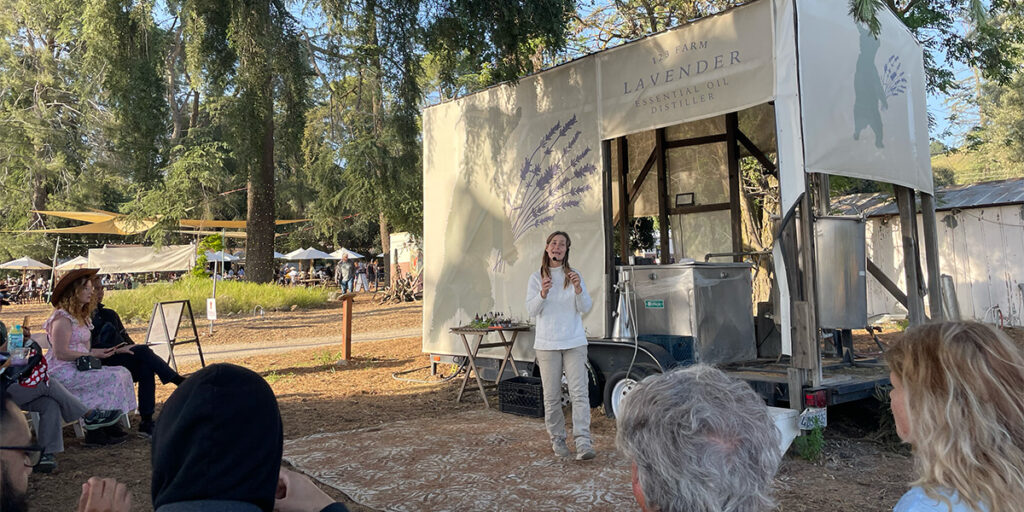
Tina demonstrating the process of distilling lavender essential oil from lavender flowers grown on the property.
Regenerative agriculture is sort of like partnering with nature to yield crops—it is old, ancient knowledge. Would you walk us through your journey to regenerative practices?
Tina: I’ve always been interested in the soil and planting things like cover crops to improve the microbes and health of the soil. I’ve always heard that soil is life. I’m from Ohio, and when I came here 20 years ago, it was through work and seeing the need for a lot of water and irrigation. It’s so dry here and there’s so many pests. When I first came here, we had a no-kill policy. But it was really difficult to continue because we’re so out of balance. Anything that I planted, I’d come back and the crops would be just gone.
What did you change, or do differently?
Tina: We needed to change the way we work. I started talking and sharing with other people and we realized we have to work with nature instead of against nature. Lavender was one of the first things we planted, and we noticed the animals didn’t bother it. So, we started planting things other animals stayed away from. Instead of trying to fight nature, we started to plant more natives and species that the animals wouldn’t bother with, like smelly herbs and olive trees and things that really fit the climate.
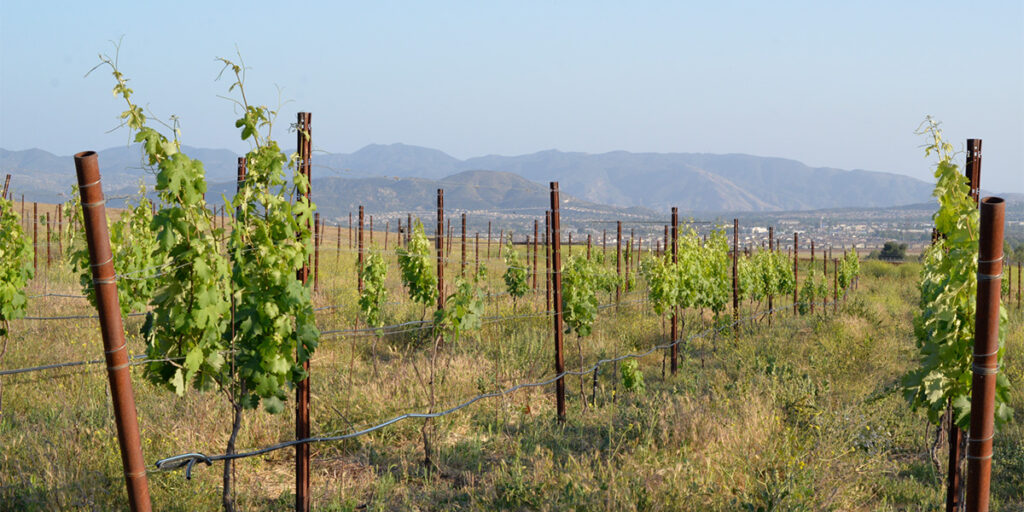
At Highland Springs Ranch & Inn, Black Bench wine is produced with regenerative and organically farmed grapes.
I think that was the start—it changed our thinking. An example is the grape field. When we first planted it, there was nothing but grass. After we planted the grapes, we added pomegranates and figs, and suddenly there were all these birds coming to the area and every year you would see new species and more birds. Watching that process from 2022 until now has been such a joy, seeing that land become more alive. There is a bobcat that’s really helping control gophers and squirrels. We still have trouble with squirrels destroying crops, but our hope is that in the future the hawks and other predator species will help us get to a better balance.
Another way you are working with nature is practicing Hugelkultur, which is the process of creating shallow berms using buried logs, and organic matter to slow and store surface water. It’s kind of like what beavers would do before we decimated the beaver populations. It was wetter and marshier in Southern California when there were beavers.
Stefan: Yes, I just heard about this on a podcast. I wasn’t aware what good they are for the land and how they contribute so much to the diversity of trees, plants and animals, and especially amphibians. That concept goes along with what Tina mentioned when we set up the grape fields. I wanted to come up with something meaningful for the shapes of the fields. Around the field there were the creek beds and edges of the hills and forest, but there was nothing in the grape field. But, as we started looking deeper, we discovered these existing low berms and realized there was a system behind them. First Peoples probably built these berms to avoid erosion and keep the water on the land.
Later, Jonas, the winemaker, told me this is an important part of regenerating the soil. We were so fascinated and it became something we rediscovered. It was not complicated, and they are very simple measures, and also very beautiful. We didn’t find it in the books, or on the internet—we found it on our land.
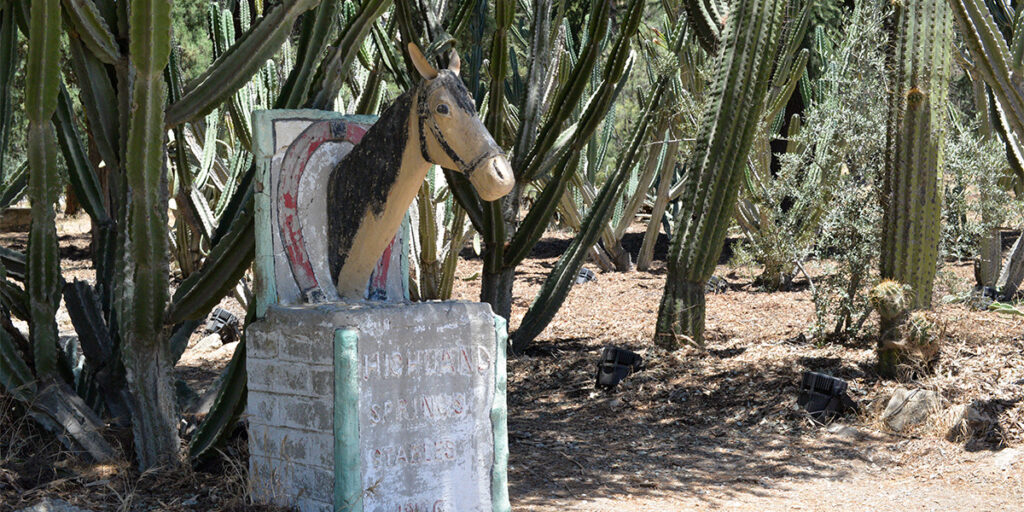
Historic artifact on site referencing a time when the site was a stagecoach stop and had horse stables.
Stefan, you are an architect from Germany and are attracted to the historic structures at the ranch. What stories are embedded in the architecture that are relevant to visitors today?
Stefan: When arriving from Europe to the US, there is a cultural shock. Everything is new. There are some cities with historic architecture, but when you go to a regular American medium-sized town, the new developments all look the same. It’s starting to look the same everywhere worldwide, there’s no difference anymore between places. We’re losing that culture and difference everywhere.
I’m old enough now to have witnessed the loss of history and culture embedded in places and it is even inside people’s minds; they cannot draw from references of the past anymore. But, when you arrive from these places to Highland Springs Ranch & Inn, it’s like a relief and you analyze, “Why is it?” And then you realize there are still a lot of old buildings and it feels very natural, very organic.
It takes a lot of effort to restore old buildings and replacing one old building doesn’t seem like a big deal, but in the long run, you lose the whole thing. At Disneyland, or Las Vegas, people go to great effort to come up with some iconic, historic building and copy it and build it there and think they have the same thing, but obviously, it’s not. At Highland Springs Ranch & Inn, you have those buildings and individually, they may not be significant, or grand but together they constitute this place as a whole. We have to preserve it.
What are some challenges with restoring and repurposing older buildings?
Stefan: Accommodating new functions in the old buildings is a very tricky thing. If you strip the building from the original use, that does something with the integrity of the building. We keep the building functions as much as possible, or if they cannot be kept, we keep the reference of what it used to be so you can still feel what was there before.
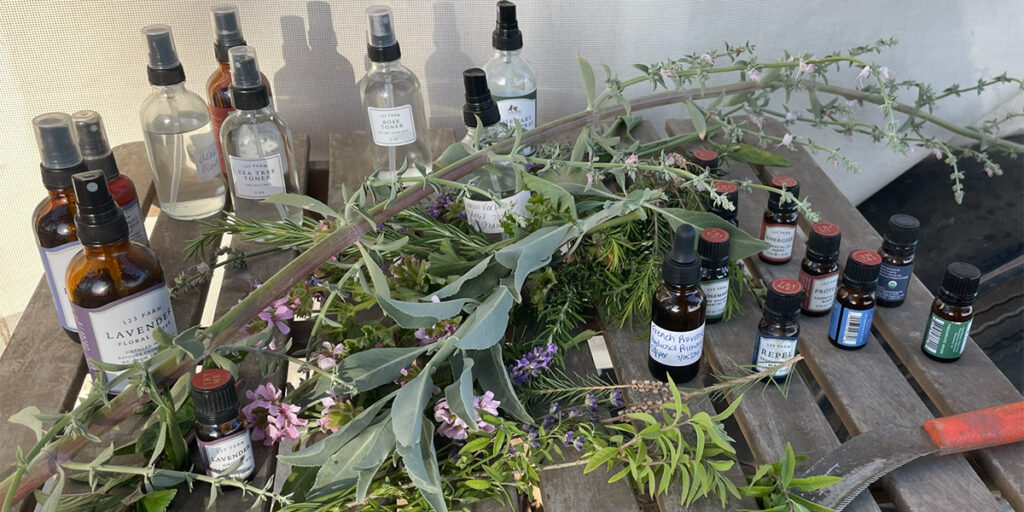
Sample of products produced from crops grown at Highland Springs Ranch & Inn.
What is your process for bringing a product to the market? Do you make what you, your friends and family want to use, or do you complete a market analysis for new products?
Tina: We started out very small and it’s grown. The first year of the Lavender Festival, we made Lavender essential oil, Lavender hydrosol, and Lavender lotion and everything we could do in-house. And now we go out to other companies and have them make products for us. It will be our essential oil, but it will be their base lotion, and they’ll make it and then we’ll give them the label and they’ll bottle it for us. We now have a person in charge of products and she does a lot of product research, but sometimes we’ll produce a product we just really like. Calendula grows so well here, and nothing eats it so we’re making a Calendula cream. It’s supposed to be really good for eczema. It’s also good for people who have had chemotherapy. If it grows well here, we try to find products that match it.
What are you hopeful about?
Tina: We are planting a lot of oak trees. We had a free oak tree planting event last year, where we gave away 159 oak tree seedlings to our neighbors. Oaks are a keystone species, which brings all kinds of wildlife, and so we’re trying to expand into the community. We are growing valley oaks and several different oak species and even experimenting with our own oaks. Our neighbors want to take 40 of our seedlings and plant them on their golf course. Our hope is that we are influencing our community. Now that we’re more profitable, we can use the farm as an educational tool and show our neighbors, this is how to regenerate your golf course. The farm is never going to make a killing, but we’re transitioning to ways that regenerate the land and expand our footprint.
Stefan: I hope a lot of what we are doing with the master plan does happen and some of the things don’t. It’s a combination of keeping what we have and making it possible to keep. We have to actually make it work; we cannot just make a museum out of it. The place is not perfect, it’s not shiny—but it has something approachable and, in a way, very human because we also are not perfect. As the buildings get older they also have a right to turn old, graciously.